
Best practices for agile software engineering takes center stage, beckoning readers into a world of efficient development strategies. Agile software development, with its iterative approach and emphasis on adaptability, has revolutionized the industry. This overview delves into the key aspects of agile methodologies, highlighting their significance in modern software engineering.
Exploring concepts like continuous feedback, cross-functional teams, and the benefits of agility, this discussion aims to provide valuable insights for individuals and organizations seeking to optimize their software development processes.
Best practices for agile software engineering
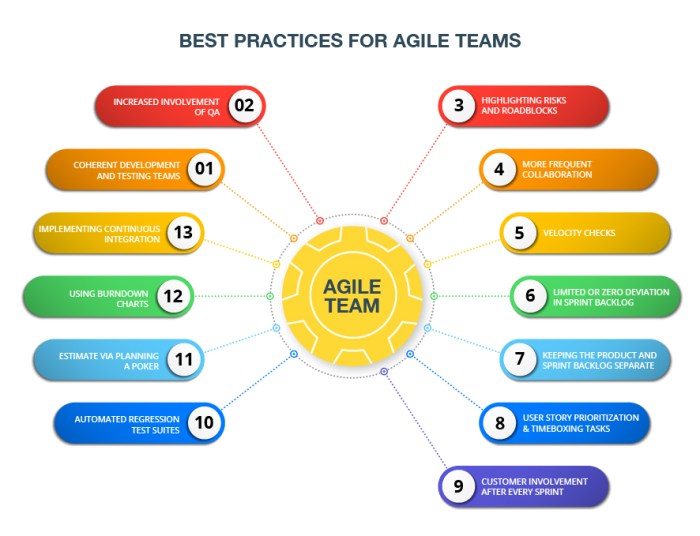
Agile software development is a methodology that focuses on iterative and incremental development, allowing for flexibility and the ability to adapt to changes throughout the project. This approach emphasizes collaboration, customer feedback, and the delivery of working software in short, frequent iterations.
Benefits of using agile methodologies in software engineering
- Increased flexibility to respond to changing requirements
- Enhanced collaboration and communication among team members
- Early and continuous delivery of valuable software to customers
- Improved quality through frequent testing and feedback
Importance of continuous feedback in agile practices
Continuous feedback is crucial in agile practices as it allows teams to make adjustments quickly, identify issues early on, and ensure that the final product meets customer expectations. This feedback loop helps in improving the product incrementally and maintaining a focus on delivering value to the customer.
Role of cross-functional teams in agile software development
Cross-functional teams in agile software development consist of members with diverse skills and expertise, working collaboratively towards a common goal. These teams are self-organized, empowered to make decisions, and responsible for delivering high-quality software. By having different perspectives and skill sets within the team, they can address complex problems efficiently and produce innovative solutions.
Software engineering Microservices architecture
Microservices architecture in software engineering is an approach where an application is composed of small, independently deployable services that work together to form the overall application. Each service is responsible for a specific function and communicates with other services through well-defined APIs.
Comparison with Monolithic Architecture
In contrast to monolithic architecture, where the entire application is built as a single unit, microservices architecture allows for greater flexibility and scalability. With microservices, each service can be developed, deployed, and scaled independently, making it easier to update and maintain the application.
- Microservices enable teams to work on different services simultaneously, promoting faster development cycles.
- Monolithic applications can become complex and difficult to manage as they grow, while microservices offer better modularity and isolation of concerns.
- Scaling a monolithic application usually involves scaling the entire application, whereas microservices allow for targeted scaling of specific services based on demand.
Advantages of Using Microservices, Best practices for agile software engineering
Microservices architecture brings several benefits to software development:
Scalability: Microservices can be independently scaled, allowing for efficient resource utilization and cost-effective scaling.
Flexibility: Teams can choose the most appropriate technology stack for each service, optimizing performance and development speed.
Resilience: Failure in one service does not bring down the entire application, as other services can continue to function independently.
Challenges and Considerations
Implementing microservices architecture comes with its own set of challenges and considerations:
- Complexity: Managing communication between services and ensuring consistency across the application can be challenging.
- Deployment: Coordinating deployments of multiple services and maintaining version compatibility can require careful planning.
- Monitoring: Monitoring and debugging a distributed system of microservices can be more complex than with a monolithic application.
Summary
In conclusion, adopting best practices for agile software engineering can lead to enhanced collaboration, faster delivery of high-quality products, and improved customer satisfaction. By embracing the principles of agility and incorporating them into everyday workflows, teams can navigate the complexities of software development with ease and efficiency.
Clarifying Questions
What are the key benefits of using agile methodologies in software engineering?
Agile methodologies promote flexibility, transparency, and faster time-to-market for software products.
How important is continuous feedback in agile practices?
Continuous feedback is crucial in agile practices as it enables teams to adapt quickly, identify areas for improvement, and enhance product quality.
What role do cross-functional teams play in agile software development?
Cross-functional teams bring together diverse skill sets and perspectives, fostering collaboration and innovation in agile software development projects.
What are some common challenges when implementing microservices architecture in software development?
Common challenges include managing distributed systems, ensuring communication between microservices, and maintaining consistency across services.


